Breaking apart
At the intersection of memory and drawing, “fragmentation” is a way for me to deliberately break apart and distance myself from past experiences and images.
As Gaston Bachelard writes in The Poetics of Space, “space is not a geometric space, but a space experienced by the inner self; a space we re-live in our memories” (Bachelard, 1994). This idea helped me see memory differently—not as a complete, frozen container of the past, but as something more flexible: a spatial experience that can be broken down, reassembled, and brought back to life through the act of making art.
This shift in thinking comes from how I personally respond to memory. I often feel out of sync with the real world and instead get stuck in memories and fantasies—some beautiful, some ordinary, some quietly sad. Reality keeps changing and moving, but the inner world I build feels still and untouched. There are certain moments I return to again and again, like the afternoon I painted in the first term work (That Day We Ran by the Water). It was such a vivid and comforting memory that it even shows up in my dreams. I became so drawn to this inner space that I tried lucid dreaming to explore it more deeply. Over time, I learned how to guide my dreams, and the line between dream and waking life started to blur.
But I also realized that staying in that kind of fantasy for too long can make time feel frozen—as if nothing moves forward. So, I started to break those memories apart, like taking a dream and separating it into smaller, clearer pieces that I could see and paint. From this perspective, memory isn’t a sealed-off space anymore; it’s more like a textured field made of feelings, small details, and the atmosphere of space. Each shift of light or change in shadow becomes part of how I remember, not just what a place looked like, but how I felt in it. As Bachelard suggests, we don’t just remember spaces—we remember what it was like to live in them. Fragmentation, then, isn’t about destroying memory, but about making it possible to reconnect with it in a new way.

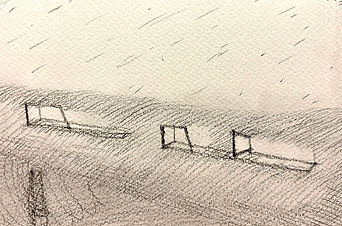
Part of Those Days, 2025

I try to break down memories that seem complete or linear, freeing them to exist as independent “spatial fragments.” Like Bachelard’s symbolic descriptions of attics or drawers, these fragments carry emotional and symbolic meaning. This tendency to “reorganize” memory resonates with the concept of postmemory proposed by Marianne Hirsch. Hirsch describes postmemory as a form of memory that is not based on direct experience, but is instead inherited and constructed through images, narratives, or symbolic representations. Despite its indirect nature, this type of memory is emotionally charged and visually powerful, often blending elements of reality and imaginatio. They don’t aim to represent reality accurately, but instead reflect how the mind revisits space. Fragmentation here isn’t just about taking things apart visually—I also try to disturb and reshape how time and space behave in the work. This kind of brokenness doesn’t mean chaos or confusion; it’s a deliberate way to stop fantasy from fully taking over. By doing this, I hope to build a different way of understanding both myself and the world around me.

Sketches, 2025
In my drawing practice, I attempt to deconstruct figurative memories into fragmented pieces. This act of dismantling is not only a re-interpretation of “space,” but also a revelation of the fissures between visual and psychological perception. Each painting seeks to extract a specific scene from memory, no longer striving for completeness, but instead preserving its hazy, indistinct state. Lines of rain run through multiple compositions—not merely as representations of nature, but as a psychological sense of fluidity: memory is not static; it is constantly washed over and reshaped in the mind.


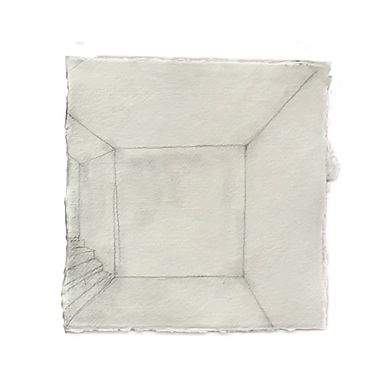

Container, 2025
References
1. Bachelard, G. (1994). The Poetics of Space (M. Jolas, Trans.). Beacon Press.
(Original work published 1958)
2. Hirsch, M. (2012). The Generation of Postmemory: Writing and Visual Culture After the Holocaust. Columbia University Press.