Reading Gaston Bachelard’s The Poetics of Space has been a profound source of inspiration for me. I gradually came to understand that space is not merely an objective geometric structure, but a presence activated by inner experience. As Bachelard writes, space is “a space we re-live in our memories.” It carries personal emotions, fantasies, and recollections—serving as a container for our subjective lived experiences. This understanding has reshaped my perception of space: rooms, staircases, doors, and windows are no longer just physical elements, but emotional and mnemonic triggers that are often reassembled and reawakened in the mind in a non-linear, illogical manner.
This poetic quality of space has deeply influenced my artistic practice. In drawing, I no longer attempt to reconstruct complete scenes, but instead respond to the nonlinearity and uncertainty of memory through fragmented compositions, blurred outlines, and repeated imagery. I have come to see space as an intersection of emotion and time—a place where the mind dwells. It is within these small, intimate spaces that I find clues to express internal emotion and reconstruct memory.
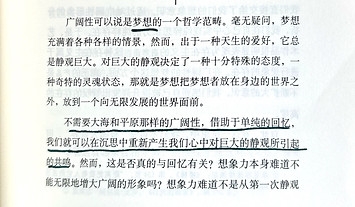
“Without needing the vastness of oceans or plains, we can, through simple memories, recreate in contemplation the resonance evoked in our hearts by a profound stillness.”

“Thus, it seems that it is through their “vastness” that inner space and world space become harmonious. When a person’s profound solitude deepens, these two expanses come into contact and intermingle.”

“The white cottage sat at the bottom of a small valley surrounded by towering mountains, as if swaddled in a cradle made of thick shrubs.”

“We should affirm that the house is a powerful force of integration, blending one’s thoughts, memories, and dreams. In this fusion, the principle of connection is dreaming. The past, present, and future each endow the house with different forms of vitality—vitalities that often interfere with one another, sometimes in opposition, sometimes in stimulation.”


